
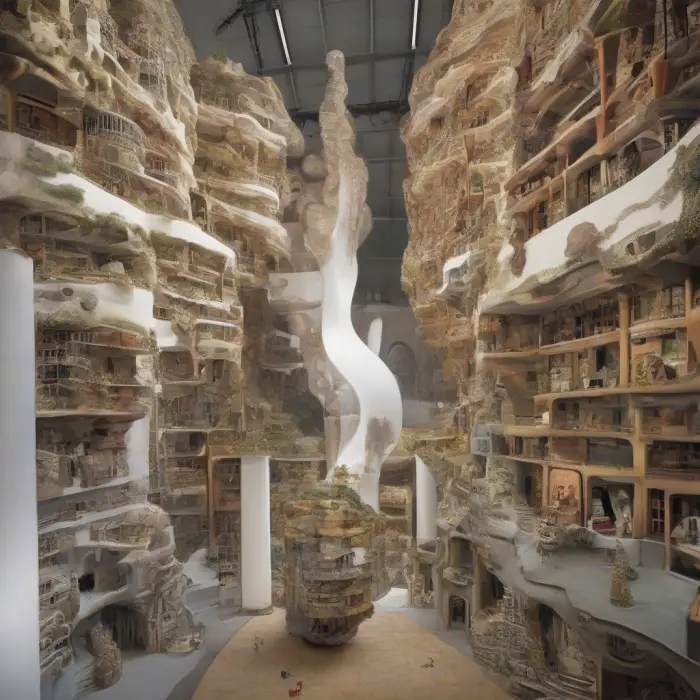


Cappadocia’s Multi-Level Cities, Türkiye
Under the soft volcanic rock of central Türkiye lie elaborate, multi-level cities—some descending dozens of meters—that sheltered entire communities for centuries. Derinkuyu and Kaymaklı are the most famous, but they’re part of a wider constellation of subterranean settlements carved over millennia.
- Derinkuyu drops roughly 60 meters and spans as many as 18 levels. At its peak, it may have housed up to 20,000 people along with livestock and supplies.
- Massive circular “rolling-stone” doors—some weighing close to a ton—sealed passages to slow invaders while allowing defenders to attack through small apertures.
- The central ventilation shaft, more than 50 meters deep, doubled as a well. If attackers poisoned wells on the surface, residents could still draw water from below.
- Rooms weren’t random: archaeologists have identified stables, wineries, kitchens with soot-blackened ceilings, chapels, storage areas, and even a long, vaulted chamber thought to be a school.
- Kaymaklı is arranged around a large ventilation shaft with homes, workshops, and storage clustered like a vertical village; four of its eight known levels are open to visitors.
- Nearby Özkonak features narrow ducts believed to have served for communication between levels—and small holes above doors that could have been used to pour hot oil on intruders.
- Local lore says some sites were rediscovered by chance in the 20th century—famously, a homeowner renovating his basement allegedly broke into a void that led to Derinkuyu’s maze.
- While some passages are said to connect cities over long distances, many of these links remain unverified and are an active subject of ongoing research.
Ħal Saflieni Hypogeum, Malta
A UNESCO-listed masterpiece carved between roughly 3600 and 2500 BCE, the Hypogeum is a subterranean temple and necropolis—the oldest known underground sanctuary of its kind.
- Spread over three levels, the complex features smoothly sculpted chambers, trilithon doorways, and spiral motifs painted in red ochre that have survived for millennia.
- The “Oracle Room” is famous for its acoustics: a voice intoned at specific pitches resonates eerily through adjacent halls.
- Thousands of human remains were interred here, suggesting elaborate ritual use and a complex prehistoric spiritual life.
- Visitor numbers are strictly limited to preserve humidity and temperature balance; it’s among the most carefully protected archaeological sites in Europe.
Longyou Caves, China
Discovered in 1992 after villagers pumped water from a pond, the Longyou Caves in Zhejiang Province revealed a cluster of enormous, hand-carved caverns—each hall large enough to swallow a building.
- More than twenty man-made grottoes exhibit uniform chisel marks across walls, pillars, and ceilings—evidence of immense, coordinated labor.
- No ancient texts clearly describe their construction, leaving their precise date, patrons, and purpose a puzzle. Estimates often place them over 2,000 years old.
- Some caverns rise tens of meters high with complex internal supports—yet remain remarkably stable.
- Even after being pumped dry, several caves show minimal water seepage, suggesting ancient builders mastered drainage and waterproofing techniques.
Paris Catacombs, France
Below the City of Light, a former limestone quarry network holds an ossuary of staggering scale—an underground memorial created in the late 18th and 19th centuries when overflowing cemeteries threatened public health.
- Remains of an estimated six million Parisians were carefully arranged along corridors, forming haunting walls of skulls and bones.
- The official route is a small fraction of the sub-surface maze; the larger network extends for hundreds of kilometers across different quarry levels.
- Illicit explorers—“cataphiles”—have mapped forgotten galleries, revealing secret art spaces, a clandestine cinema once discovered by police, and historic inscriptions.
- Signage warns: “Stop! This is the Empire of the Dead,” reminding visitors of the site’s solemn purpose.
Odessa Catacombs, Ukraine
Born from centuries of limestone quarrying, Odessa’s catacombs form one of the world’s most extensive urban labyrinths—a honeycomb beneath the Black Sea port city.
- Estimates suggest more than 2,500 kilometers of tunnels and galleries, dwarfing many other underground networks.
- During World War II, partisan groups hid within the maze; parts now serve as museums documenting this clandestine history.
- With few reference points and unstable air pockets, the catacombs are notoriously disorienting—guided, sanctioned visits are the safe way to explore.
Naours Underground City, France
Near Amiens, a medieval refuge city was carved into chalk bedrock: a secure, hidden town where locals weathered invasions and religious wars.
- Stretching roughly 3 kilometers with hundreds of rooms, Naours could shelter entire villages—people, animals, and supplies—during crises.
- Thousands of World War I-era inscriptions by soldiers were rediscovered in the 2010s, turning its walls into a poignant ledger of names, units, and home towns.
- Complex ventilation and smoke-blackened cooking spaces attest to planned, long-duration habitation below ground.
Italy’s Subterranean Worlds: Orvieto and Naples
Several Italian cities sit atop older versions of themselves. In volcanic tuff and soft bedrock, generations carved cisterns, workshops, and entire street systems that mirror the life above.
- Orvieto’s hill is riddled with more than a thousand man-made cavities: olive presses, pigeon lofts carved into walls, wells, and escape passages—a microcosm of medieval urban life underground.
- Naples’ labyrinth began as Greek and Roman aqueducts and expanded with quarrying; in World War II, tens of thousands of residents sheltered here from air raids.
- The Bourbon Tunnel—commissioned in the 19th century—later doubled as a wartime refuge, storing vehicles, statues, and supplies out of harm’s way.
Beijing’s Underground City (Dixia Cheng), China
Built in the 1970s amid Cold War anxieties, Beijing’s subterranean shelter network was designed to protect civilians from potential attacks and to sustain life below the surface.
- Known popularly as an “underground city,” the system reportedly included clinics, storerooms, and assembly spaces, with numerous concealed entrances in central districts.
- While some sections opened briefly to tourists in the early 2000s, many passages remain sealed, damaged, or restricted, lending the site an enduring air of mystery.
- The network reflects a unique chapter of urban planning: a city engineered with a shadow infrastructure ready to host daily life in an emergency.
Nushabad (Ouyi) Underground City, Iran
Beneath the desert town of Nushabad near Kashan lies a multi-level refuge city carved in the Sasanian era and reused for centuries during raids and wars.
- Revealed to the modern world in the 2000s when a resident stumbled into a void during construction, the complex extends across multiple levels, some more than 10 meters deep.
- Narrow corridors, dead-ends, and cleverly hidden entrances under house floors formed layers of defense.
- Ventilation shafts disguised as wells and small niches suggest long-term occupation was planned, not improvised.
Coober Pedy, Australia
Unlike ancient labyrinths, Coober Pedy is a living underground town—born from opal mining and sustained by the need to escape the searing Outback heat.
- A significant share of the population lives in “dugouts” carved into hillsides. Underground homes maintain a remarkably stable temperature year-round.
- The town features subterranean churches, galleries, and hotels—complete with skylights and ventilation shafts.
- What began as practical shelter evolved into an architectural identity, making Coober Pedy one of the world’s few thriving modern underground communities.
Củ Chi Tunnels, Vietnam
Though not a city in the conventional sense, the Củ Chi Tunnels formed a vast wartime underworld with living quarters, hospitals, and command posts—an occupied landscape beneath the battlefield.
- The network stretched for hundreds of kilometers at its peak, arranged on multiple levels connected by narrow passageways and hidden trapdoors.
- “Smokeless kitchens” dispersed cooking fumes to avoid aerial detection—a subtle but vital innovation.
- Today, widened sections provide a glimpse of the extreme conditions that defined this subterranean way of life.
Erdstall Tunnels, Central Europe
Scattered across Bavaria, Austria, and beyond are mysterious hand-dug tunnels called “Erdställe”—tight, winding passages so small that many must be traversed by crawling.
- Dates remain debated; many scholars place them in the medieval period, but their exact purpose—refuge, storage, ritual—is unresolved.
- Characteristic “schlupf” squeeze passages connect tiny chambers, suggesting deliberate design rather than random digging.
- Local folklore calls them “dwarf holes,” reflecting centuries of wonder about who built them and why.
What These Underground Cities Reveal
Across continents and centuries, subterranean worlds tend to solve the same human problems—how to survive, store, worship, and wait out danger—using local geology and shared ingenuity.
- Climate control: Underground spaces maintain stable temperatures, vital in deserts and volcanic plateaus.
- Defense by design: Narrow choke points, hidden entries, and heavy stone doors are recurring features across distant cultures.
- Air and water engineering: Ventilation shafts serve double duty as wells, smoke outlets, and lifelines.
- Cultural memory: Inscriptions, chapels, and ritual halls—whether prehistoric Malta or modern catacomb graffiti—turn rock into an archive.
- Elastic urbanism: From Naples to Orvieto and Beijing, cities plan for a second, hidden layer—sometimes ancient, sometimes modern, always adaptive.
Visiting Responsibly
Many underground sites are fragile, sacred, or both. To experience them responsibly:
- Book official tours and respect capacity limits—especially at sensitive archaeological sites.
- Avoid off-limits tunnels; unauthorized entry is dangerous and often illegal.
- Wear sturdy footwear, bring a light if permitted, and be mindful of low ceilings and uneven floors.
- Leave no trace: oils from fingers, litter, or stray markings can cause lasting damage.
Underworlds of Ingenuity
Whether carved to outlast enemies, the seasons, or time itself, the world’s underground cities testify to human resilience and creativity. Each chamber and corridor solves a problem—inventively, invisibly, and often beautifully. Step carefully, listen closely, and you may hear the echo of a thousand hidden lives.