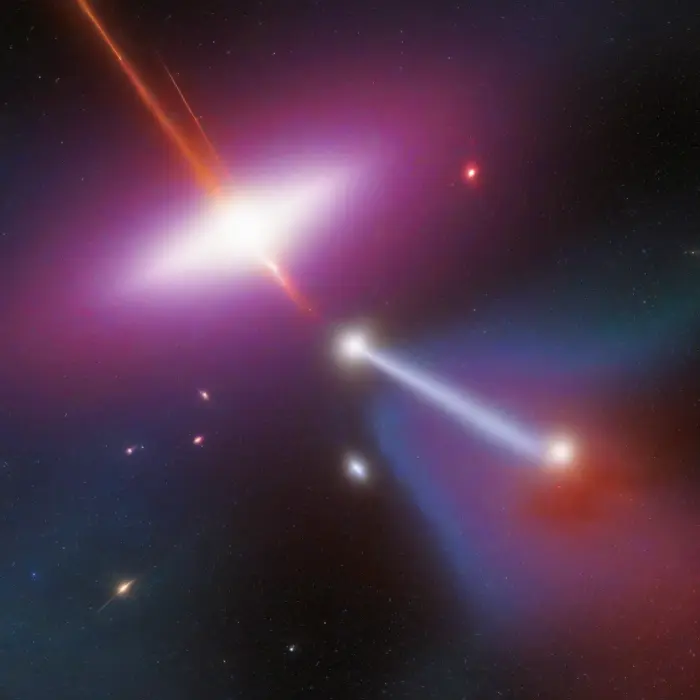


"Silicon Breached the Neon Layer": Chandra Observatory Reveals Massive Star's Violent Internal Collapse Before Supernova Explosion
By Rude Baguette Science Desk
In a breakthrough that turns textbook diagrams of dying stars into a visceral narrative of turbulence and rupture, astronomers leveraging NASA’s Chandra X-ray Observatory have pieced together a dramatic prelude to a supernova: silicon-rich plumes surged outward and punched through the neon shell in the star’s final hours to days. The result is a more chaotic, more three-dimensional picture of how massive stars actually die—one that helps explain why supernova blasts are so asymmetric and why their element yields vary so widely.
“Silicon breached the neon layer.”
While the internal convulsions of a star are invisible in real time, Chandra’s high-resolution X-ray maps of the supernova debris—combined with advanced 3D simulations—let researchers rewind the clock. The spatial distribution, temperatures, and Doppler motions of neon, silicon, sulfur, and iron in the remnant act like forensic clues, pointing to a pre-explosion phase when convective silicon-burning flows became so vigorous that they overcame the entropy barrier at the base of the neon layer. That breach seeded the blast with large-scale asymmetries, steering the violence of the explosion that followed.
The onion that wasn’t: Late-stage stars are messy, not layered
For decades, the “onion-skin” model of massive stars presented neat, concentric shells: iron at the center, then silicon, oxygen, neon, carbon, helium, and hydrogen in sequence. Reality, especially in the last weeks to hours before collapse, is far messier. As nuclear burning accelerates from carbon (years) to neon (months) to oxygen (months) to silicon (days), the star’s interior becomes a storm of supersonic turbulence, shell mergers, and violent convection.
Silicon burning—fusing lighter elements to build an iron core—releases energy so rapidly that buoyant plumes form and crash against neighboring shells. In cutting-edge simulations, these plumes can merge shells, redistribute heat, and create density perturbations that later help the stalled shock wave revive into a full-blown supernova. The new Chandra-led reconstruction provides observational support for one such event: silicon-rich material intruding into and mixing with the neon layer.
What Chandra actually sees
Chandra is sensitive to X-ray photons from hot plasma at tens of millions of degrees—exactly what we expect when supernova ejecta plow into circumstellar gas or when reverse shocks heat the innermost debris. By separating the X-ray spectrum into narrow energy bands, astronomers produce element maps: neon (Ne IX, Ne X), silicon (Si XIII, Si XIV), sulfur (S XV, S XVI), and iron (Fe K).
- Elemental segregation and overlap: In the remnant, bright silicon-rich knots are found not only where they “should” be but also interleaved with and ahead of neon-rich material.
- Doppler asymmetries: Shifts and broadenings in the emission lines reveal silicon clumps moving at markedly different speeds and directions compared to neon-dominated gas—signatures of a pre-explosion mixing event.
- Thermal contrasts: Regions with silicon show different temperature-ionization histories than adjacent neon zones, consistent with plumes that originated deeper and were launched outward before or during the explosion.
When these observational fingerprints are fed into 3D hydrodynamic models, the best-fit scenario is one in which vigorous silicon-shell convection breached the base of the neon layer shortly before core collapse. That breach sculpted the density field into large lobes and fingers—patterns that the explosion later amplified.
Why this breach matters
- Explosion asymmetry and shock revival: Pre-collapse perturbations seed the stalled shock with buoyant plumes that can help “kick” the explosion into motion. This explains why many supernovae are inherently lopsided.
- Element yields and galactic chemistry: Mixing alters which layers are heated and ejected. That reshapes the production and distribution of key isotopes such as 56Ni (which powers the light curve) and 44Ti (observable in young remnants).
- Neutrino and gravitational-wave signals: Strong, late-time convection creates time-varying mass motions, imprinting distinct flickers in the neutrino flux and potential gravitational-wave chirps—valuable targets for next-generation detectors.
- Pre-supernova outbursts and mass loss: Shell mergers and breaches can trigger surface responses—radiative shocks and eruptions—that dump matter into the star’s surroundings, setting the stage for bright shock–CSM interaction after the blast.
From neat layers to living turbulence: a quick timeline
- Months–years before collapse: Neon and oxygen burning proceed in shells; convection intensifies.
- Days before collapse: Silicon burning ignites; convective Mach numbers rise. Plumes swell.
- Hours before collapse: Turbulent silicon plumes breach the neon layer, partly merging shells and seeding large-scale asymmetry.
- Core collapse (milliseconds): Iron core implodes; a rebound launches a shock that initially stalls.
- Shock revival (hundreds of milliseconds): Neutrino heating and pre-seeded turbulence push the shock outward.
- Days–years after explosion: Ejecta crash into circumstellar material; Chandra maps the chemistry and kinematics—allowing a forensic reconstruction of the star’s final internal convulsions.
How the team connected the dots
The reconstruction rests on a loop between data and simulation:
- Spectral imaging: Narrow-band X-ray maps isolate emission from Ne, Si, S, and Fe, revealing distinct morphologies.
- Velocity tomography: Line shifts provide line-of-sight speeds; proper motions track expansion on the sky.
- Non-equilibrium ionization modeling: Fits to the plasma state show different heating histories for neighboring clumps—evidence of distinct origins.
- 3D hydrodynamics: Simulations with shell burning and convection are tuned until they reproduce the observed element interleaving and velocity field. Only models with a late silicon–neon breach match the data.
Implications for the next decade
This work anchors a new paradigm: supernovae remember their progenitors’ final turbulence. With Chandra’s maps as a foundation, upcoming observatories will sharpen the picture:
- XRISM and Athena: High-throughput, high-resolution X-ray spectroscopy will resolve line profiles and turbulence directly in young remnants.
- JWST and ELTs: Infrared and optical spectra will trace complementary elements and dust condensed from mixed layers.
- Neutrino/gravitational-wave detectors: Signatures of late-stage convection will be targeted in the next nearby core-collapse event.
Together, these tools will let astronomers move from “onion skins” to living interiors—stars as dynamic systems whose terminal throes leave indelible fingerprints.
Key takeaways
- Chandra’s X-ray maps of supernova debris, paired with 3D models, indicate that silicon-rich plumes breached the neon layer before core collapse.
- This breach seeded asymmetries that helped power and shape the explosion, altering element yields and remnant morphology.
- The result bridges simulations and observations, reframing late stellar evolution as a turbulent, shell-merging phase rather than a tidy sequence of static layers.