

Mind-Blowing Facts About the Art of Holography and Its Applications
From shimmering portraits that change as you walk to instruments that measure atomic-scale motion, holography sits at the intersection of art, optics, and engineering—packing more surprises than most realize.
Holography isn’t just a neat trick with lasers—it’s a way to capture and recreate the full wavefront of light reflected from a scene. Unlike a photograph, which records only brightness and color, a hologram stores phase information too. That’s why a hologram can conjure a lifelike 3D view that shifts as you move, with depth cues your eyes and brain instinctively trust.
Below, explore how holography works, the varieties artists and engineers use, wild facts that seem like optical wizardry, and the expanding universe of applications reshaping art, industry, medicine, and immersive displays.
How Holography Works
At its core, holography is three steps: interference, recording, and reconstruction.
- Interference: A coherent light source (usually a laser) is split into two beams. One, the reference beam, goes straight to the recording medium. The other, the object beam, reflects from the subject. Where they meet on the recording medium, they create an intricate interference pattern—microscopic fringes encoding the scene’s 3D wavefront.
- Recording: A photosensitive material (silver halide emulsions, dichromated gelatin, or modern photopolymers) captures these fringes at staggering spatial frequencies—often thousands of lines per millimeter.
- Reconstruction: Later, illuminating the developed hologram with the original reference beam (or compatible light) diffracts light so it recreates the original wavefront. Your eyes perceive a 3D object in space, complete with parallax and focus cues.
Tip: Reflection (“Denisyuk”) holograms and embossed “rainbow” holograms can be viewed in ordinary white light. Transmission holograms often require a laser or narrowband source to replay.
Mind-Blowing Facts That Make Holography Feel Like Magic
- Every part contains the whole. Cut a hologram into pieces and each fragment can still reconstruct the entire scene—just with reduced resolution and narrower viewing angles. The 3D information is distributed across the surface.
- It encodes phase, not just brightness. Holograms store how far light waves have traveled (phase). That’s why they can recreate focus cues and parallax—things ordinary photos can’t deliver without extra optics.
- Color holograms are multiple holograms stacked. True-color holography typically uses three lasers (red, green, blue). Each color’s fringe pattern is recorded in the same volume; replaying with white light reveals the composite full-color 3D image.
- They’re unbelievably fine-grained. Many holographic materials resolve 3,000–10,000 lines per millimeter. For perspective, a human hair is about 70,000 micrometers wide; a single fringe can be well under a micrometer.
- They shift color with humidity and temperature. Volume (Bragg) holograms can change replay color slightly if the material swells or shrinks—because the spacing of internal fringes sets the wavelength they reflect.
- Rainbow holograms trade vertical parallax for brightness. Invented by Stephen Benton in 1968, they restrict vertical parallax to enable bright white-light viewing and produce that iconic “rainbow” shimmer as you tilt them.
- Holographic interferometry can spot nanometer changes. By comparing holograms before and after stress or vibration, engineers visualize tiny deformations—literally mapping modal shapes and resonances with fringe patterns.
- They’re not the same as “Pepper’s Ghost.” Many “hologram concerts” and display stunts are cleverly staged reflections or volumetric projections—not true holographic wavefront reconstruction.
- Holograms aren’t just optical. Electron, X‑ray, microwave, and acoustic holography reconstruct wavefronts at different wavelengths, revealing magnetic fields, internal structures, and even creating mid‑air tactile feedback.
- Mass-produced “foil holograms” are stamped. Security holograms on cards and banknotes are often embossed nano-relief patterns that diffract light—no laser needed to view, enabling low-cost, high-speed production.
- Real-time holograms exist. Photorefractive crystals and modern spatial light modulators (SLMs) can update holograms live, enabling dynamic wavefront shaping for displays, microscopy, and optical trapping.
- Femtosecond lasers can freeze the impossible. Ultrafast pulses capture interference patterns of lightning-fast events, letting researchers study shock waves and plasma dynamics in 3D.
- “Holographic storage” promises huge capacities. By multiplexing many page-like data patterns across angles or wavelengths in a thick medium, prototypes have demonstrated very high areal and volumetric densities.
Types of Holograms Artists and Engineers Use
- Transmission (Leith–Upatnieks): Viewed with a laser from the same side as the recording beam. Offers striking depth and parallax—popular in labs and studios.
- Reflection (Denisyuk/Lippmann-style): Thick (volume) holograms that replay with white light from the front. Beloved for gallery-ready display without special lighting.
- Rainbow (Benton) holograms: Bright, color-shifting holograms ideal for public spaces and mass reproduction (often as embossed foils).
- Volume vs. surface-relief: Volume holograms store fringes throughout the thickness; surface-relief holograms store them on the surface, allowing embossing into plastics and metals.
- Computer-generated holograms (CGH): Algorithms compute phase patterns to form desired 3D images when displayed on SLMs—crucial for holographic displays, beam shaping, and optical tweezers.
- Holographic interferometry and shearography: Specialized variants for measuring deformation, strain, vibration, and thermal effects with exceptional sensitivity.
- Digital holography: Records interference patterns with image sensors; numerical reconstruction reveals amplitude and phase—useful in microscopy and metrology.
- Beyond visible light: Electron, X‑ray, microwave, and acoustic holography apply the same principles to different waves and scales.
Applications That Reach Far Beyond Gallery Walls
Art, Culture, and Design
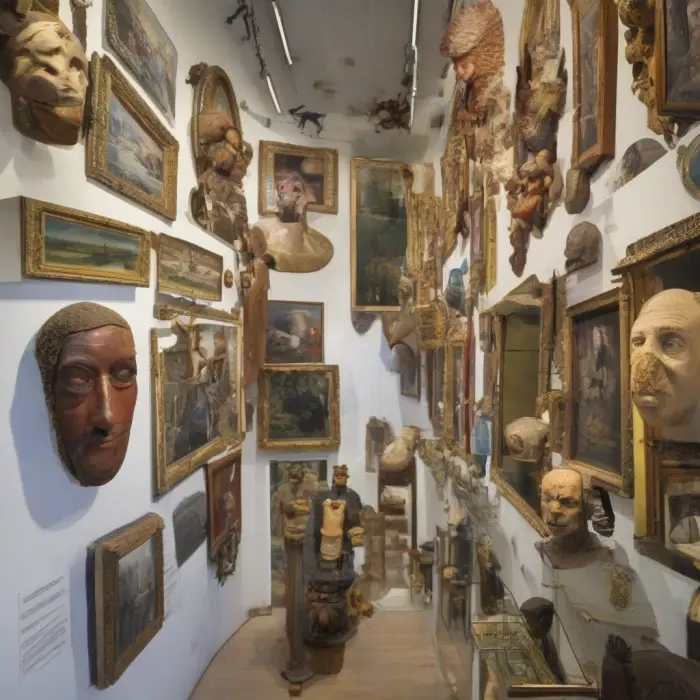
- Immersive installations: Artists craft holograms that appear to hover or recede into walls, shifting as visitors move, creating experiences photographs can’t match.
- Archival replicas: Museums holographically document fragile artifacts, capturing fine surface relief and shape in a form viewable without handling the original.
- Brand storytelling: Packaging and exhibitions use dynamic holographic elements to create motion and depth without electronics.
Security and Anti-Counterfeiting
- Banknotes, IDs, and passports: Optically variable holograms are hard to replicate accurately and can embed covert microtext and multi-level imagery.
- Product protection: Tamper-evident seals and authentication labels leverage diffractive features visible under simple lighting.
Industrial Metrology and Non-Destructive Testing
- Deformation and stress analysis: Holographic interferometry reveals tiny shape changes in aerospace components, composites, and precision parts.
- Vibration modes: Engineers visualize resonant patterns of structures (from turbine blades to violin plates) for design optimization.
Medicine and Biology
- Digital holographic microscopy: Quantitative phase imaging measures cell morphology, growth, and dynamics label-free—ideal for long-term live-cell studies.
- Ophthalmic metrology: Wavefront sensing and holographic elements help characterize and correct aberrations in the eye.
- Optical manipulation: CGHs shape light for holographic optical tweezers, creating multiple traps to move microscopic particles and cells.
Displays, AR, and HUDs
- Holographic optical elements (HOEs): Thin, lightweight gratings and lenses couple, guide, and shape light in AR glasses and head-up displays.
- Toward true holographic displays: Phase-only SLMs and “neural holography” aim to render correct depth focus cues, reducing eyestrain compared to stereoscopic 3D.
Photonics and Telecommunications
- Beam shaping and filtering: Holographic gratings tailor laser modes, stabilize wavelengths, and split or combine beams in compact optical systems.
- Integrated optics: Holographically defined structures help build compact spectrometers and sensors.
Data Storage
- Volume multiplexing: Storing many “pages” in a thick medium using different angles or wavelengths can achieve high capacities; while commercial adoption has been challenging, R&D continues.
Energy, Lighting, and Architecture
- Solar concentrators: HOEs steer and concentrate specific wavelengths onto photovoltaic cells while passing visible light for windows.
- Daylighting and glare control: Holographic diffusers spread light evenly without bulky optics.
Acoustics and Haptics
- Acoustic holography: Phased arrays project 3D pressure fields that can levitate particles or create mid-air haptic sensations you can feel.
A Lightning Timeline
- 1947: Dennis Gabor conceives holography (pre-laser), earning the 1971 Nobel Prize in Physics.
- 1960: The laser is born, enabling practical holography with coherent light.
- 1962: Emmett Leith and Juris Upatnieks develop off-axis transmission holography; Yuri Denisyuk pioneers reflection (volume) holograms.
- 1968: Stephen Benton invents the rainbow hologram for bright white-light viewing.
- 1980s–1990s: Embossed holograms scale to mass security markets; HOEs enter automotive HUDs and instruments.
- 2000s–today: Digital and computational holography flourish; AR waveguides and neural rendering push toward consumer holographic displays.
Myths vs. Reality
Myth: “Holograms are 3D images floating in mid-air like in sci‑fi.”
Reality: True holography reconstructs a wavefront from a surface. You often need a medium or screen. Many “floating” illusions are reflections (Pepper’s Ghost) or volumetric scattering in fog—impressive, but not holography.
Reality: True holography reconstructs a wavefront from a surface. You often need a medium or screen. Many “floating” illusions are reflections (Pepper’s Ghost) or volumetric scattering in fog—impressive, but not holography.
Myth: “Any shiny 3D sticker is a hologram.”
Reality: Many are diffractive optical variable devices (DOVIDs). They rely on similar physics and fabrication but may be designed with specialized e‑beam lithography rather than traditional holographic recording.
Reality: Many are diffractive optical variable devices (DOVIDs). They rely on similar physics and fabrication but may be designed with specialized e‑beam lithography rather than traditional holographic recording.
Myth: “Light-field displays are holographic.”
Reality: Light-field and multi-view displays reproduce rays (intensity along directions), while holography reconstructs full wavefronts (including phase), enabling natural focus cues with a single image plane.
Reality: Light-field and multi-view displays reproduce rays (intensity along directions), while holography reconstructs full wavefronts (including phase), enabling natural focus cues with a single image plane.
Materials and Practical Magic
- Silver halide emulsions: High resolution and sensitivity; classic for studio-quality art holograms.
- Dichromated gelatin (DCG): Delivers brilliant, low-scatter volume holograms with stunning color—but is sensitive to humidity and processing conditions.
- Photopolymers: Self-developing materials ideal for HOEs and mass production.
- Embossed foils: Surface relief replicated into plastic and metalized layers for security features at scale.
Laser safety and vibration isolation matter. Early holographers sandbagged tables and waited for quiet nights; today, diode lasers, short exposures, and sturdy mounts bring holography to classrooms and studios.
What’s Next: The Road to Everyday Holography
- Computational breakthroughs: AI-accelerated (neural) holography slashes artifacts and compute time, pushing toward real-time, natural-looking 3D imagery.
- Better modulators: Higher-resolution, faster, phase-only SLMs (including MEMS and metasurface approaches) aim to expand field of view and color while shrinking power and size.
- Near-eye holographic displays: Solving the vergence–accommodation conflict with correct focus cues could make AR/VR vastly more comfortable and realistic.
- Metasurface holography: Engineered nano-structures that bend light at will promise ultra-thin, mass-producible holographic optics for sensors, cameras, and wearables.
- Lab-on-chip imaging: Compact digital holography may deliver field-ready microscopes for telemedicine and environmental monitoring.
Inspired? Ways to Experience or Create Holography
- See art holograms in person: Museums and dedicated holography galleries reveal depth and parallax you can’t appreciate on a screen.
- Try a beginner kit: Tabletop kits with stable diode lasers and photopolymer plates let you make simple transmission or reflection holograms safely at home or in class.
- Explore digital holography: With a camera, a coherent source, and open-source software, you can reconstruct amplitude and phase numerically and learn the math behind the magic.
Always follow laser safety guidelines: use appropriate eyewear, control beam paths, and avoid reflective hazards.